
Role of AI Scripting: Complete Guide for 2025
Explore the role of AI scripting in automated video creation, types of AI script tools, real-world use cases, and best practices in this authoritative guide.
Birju
Author
Role of AI Scripting: Complete Guide for 2025

Most advice about AI scripting misses just how fast this technology is changing the workplace. With developers now interacting through eleven different AI tool types and language models generating code, translating languages, and detecting defects, the landscape has shifted almost overnight. Understanding how these systems work has become vital for anyone who creates, codes, or communicates. This guide breaks down the essentials, showing what AI scripting really means and how it is shaping the future of automation and creativity.
Table of Contents
Key Takeaways
| Point | Details |
|---|---|
| AI Scripting Revolutionizes Content Generation | AI scripting utilizes advanced language models for automated script creation, improving productivity and creativity across industries. |
| Diverse AI Scripting Tools Available | A variety of tools enable functions such as code generation, language translation, and workflow automation to address specific professional needs. |
| Critical for Future Professionals | Mastery of AI scripting is becoming essential for professionals, enhancing efficiency and enabling sophisticated, automated workflows. |
| Balance Innovation with Human Oversight | Successful integration of AI scripting requires consistent human validation and ethical considerations to mitigate risks and ensure quality. |
Defining AI Scripting and Core Concepts
- Defining AI Scripting And Core Concepts
- Main Types Of AI Scripting Tools Available
- How AI Scripting Powers Async Video Creation
- Key Benefits And Limitations Of AI Scripting
- Best Practices And Critical Pitfalls To Avoid
AI scripting represents a revolutionary approach to automated content and code generation using advanced language models and intelligent algorithms. At its core, AI scripting transforms how developers, creators, and professionals generate structured text, program code, and dynamic content through intelligent computational linguistics.
According to research from arXiv, modern AI scripting leverages transformer-based large language models trained on extensive code datasets to enable sophisticated programming tasks. These models can perform complex operations like:
- Code generation
- Automated script completion
- Code translation between programming languages
- Intelligent defect detection
A groundbreaking example of domain-specific AI scripting is the AskIt language, introduced in arXiv research. This innovative approach simplifies large language model integration by providing a unified interface for direct task execution and programmatic code generation. By abstracting complex computational processes, AskIt demonstrates how AI scripting can transform technical workflows.
The fundamental mechanics of AI scripting involve training sophisticated neural networks on massive datasets, enabling them to understand context, syntax, and semantic relationships. These intelligent systems can interpret natural language prompts and convert them into structured, executable scripts across multiple domains - from software development to creative content production. Modern AI scripting tools now provide unprecedented capabilities for automating repetitive tasks while maintaining high levels of precision and adaptability.
As we move towards 2025, AI scripting is poised to become an essential skill for professionals across industries. Learn more about AI productivity tools that are revolutionizing how we approach complex computational and creative challenges.
Main Types of AI Scripting Tools Available
AI scripting tools have rapidly evolved, presenting developers and content creators with a diverse ecosystem of intelligent solutions. Scripting technologies now span multiple categories, each designed to address specific computational and creative challenges across different domains and professional requirements.
According to research from arXiv, developers now interact with AI tools through eleven distinct interaction types. These interactions range from auto-complete code suggestions to sophisticated conversational assistance platforms. The primary categories of AI scripting tools include:
- Code Generation Tools: Automatically generate programming scripts and complete code segments
- Language Translation Tools: Convert code between different programming languages
- Conversational AI Scripting Platforms: Provide natural language interfaces for script creation
- Workflow Automation Tools: Design intelligent script sequences for repetitive tasks
Research from arXiv further illuminates the landscape by presenting a structured framework for AI agents, categorizing them into one-step and sequential models. These models demonstrate remarkable capabilities in task planning and intelligent tool usage across various applications.
Professional-grade AI scripting tools now differentiate themselves through advanced features like context understanding, multi-language support, and adaptive learning algorithms. These technologies can interpret complex prompts, understand semantic nuances, and generate precise, context-aware scripts. Explore how video scripting workflows are being transformed by cutting-edge AI technologies that are redefining content creation processes.
The most sophisticated AI scripting tools integrate machine learning models that continuously improve their performance. They analyze vast datasets, learn from user interactions, and develop increasingly refined scripting capabilities. As we approach 2025, these tools are becoming indispensable for professionals seeking to optimize their workflow, reduce manual intervention, and unlock unprecedented levels of productivity and creativity.

How AI Scripting Powers Async Video Creation
Asynchronous video creation has undergone a radical transformation with the advent of AI scripting technologies, enabling creators to produce high-quality content without traditional time and resource constraints. These intelligent systems now bridge the gap between creative vision and technical execution, revolutionizing how professionals communicate and share information.
According to research from arXiv, transformer-based large language models are pivotal in driving AI-assisted content generation. These advanced models can perform complex tasks such as:
- Generating contextually relevant video scripts
- Suggesting optimal content structures
- Adapting language and tone for specific audiences
- Translating conceptual ideas into structured narratives
Research highlighting the AskIt framework from arXiv demonstrates how domain-specific languages simplify large language model integration, providing unified interfaces for direct task execution. This breakthrough enables seamless script generation and video content planning with unprecedented precision and efficiency.
Professional async video creation now leverages sophisticated AI scripting tools that understand nuanced communication requirements. These technologies can generate scripts that capture tone, maintain brand consistency, and adapt to different communication contexts. Learn how async video features are transforming freelance workflows by eliminating traditional collaboration barriers and enabling more dynamic, flexible content production.
The future of async video creation lies in AI's ability to understand context, predict audience engagement, and generate personalized content at scale. By continuously learning from user interactions and massive datasets, these intelligent scripting systems are not just tools but collaborative partners in the creative process. They help professionals communicate more effectively, reduce production time, and unlock new levels of creative expression across diverse industries and communication channels.
Key Benefits and Limitations of AI Scripting
AI scripting represents a powerful technological paradigm that offers unprecedented capabilities while simultaneously presenting unique challenges for professionals across various domains. Understanding its nuanced landscape requires a balanced examination of its transformative potential and inherent constraints.
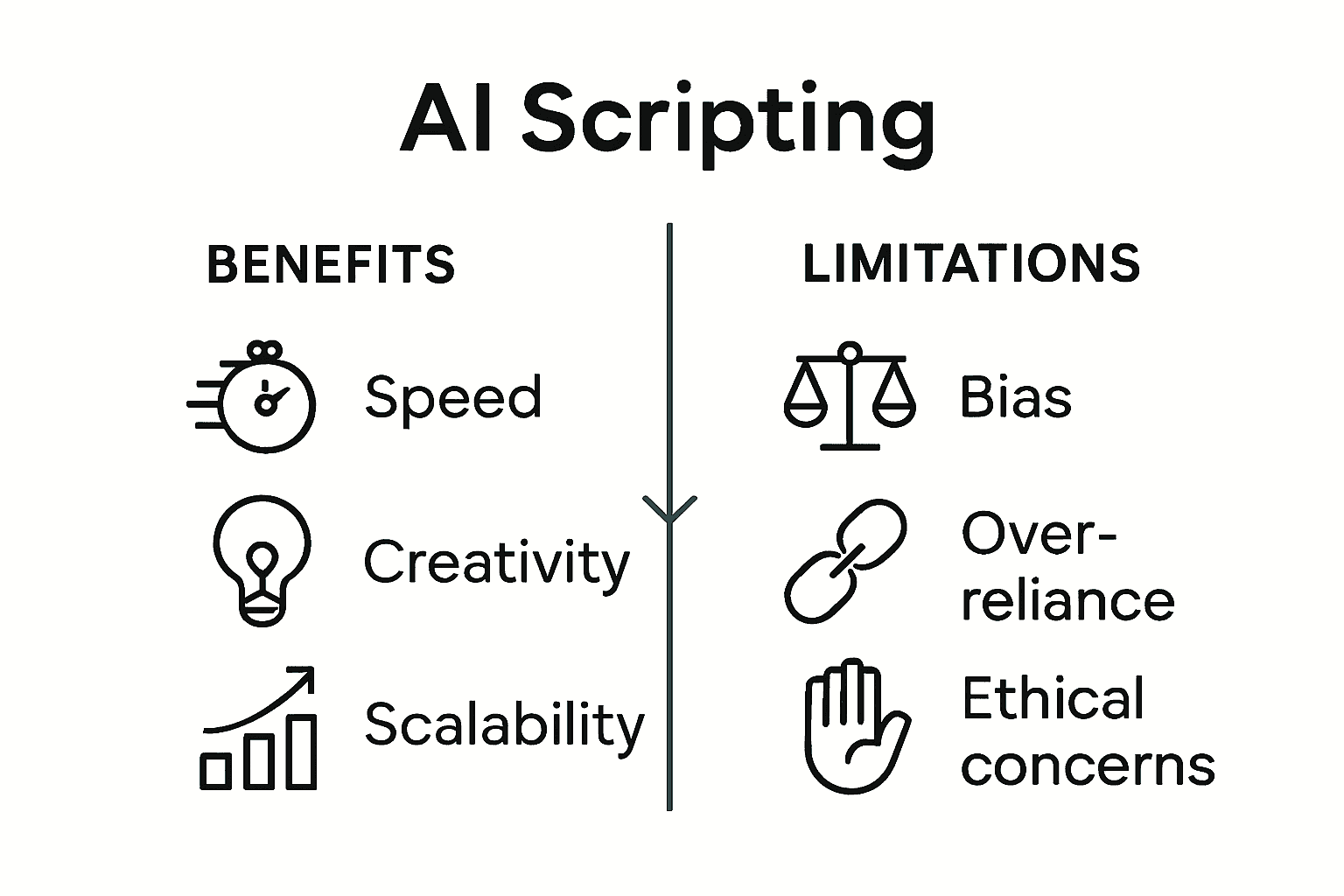
Research from arXiv reveals a comprehensive taxonomy of developer interactions with AI tools, identifying eleven distinct interaction types that underscore the technology's complexity. The key benefits of AI scripting include:
- Rapid Productivity Acceleration: Dramatically reduces time spent on repetitive tasks
- Enhanced Creativity: Generates novel content and problem-solving approaches
- Adaptive Learning: Continuously improves performance through iterative interactions
- Scalable Content Generation: Produces high-volume, contextually relevant scripts
According to arXiv, AI agents can be categorized into one-step and sequential models, each presenting unique capabilities and limitations. The sequential models, in particular, demonstrate advanced task planning capabilities that highlight both the potential and current constraints of AI scripting technologies.
However, AI scripting is not without significant limitations. Professionals must navigate challenges such as potential bias in generated content, occasional lack of nuanced understanding, and the risk of over-reliance on automated systems. Explore how understanding AI's role in content creation can help mitigate these challenges and maximize the technology's transformative potential.
The future of AI scripting lies in striking a delicate balance between technological innovation and human creativity. As these systems become more sophisticated, they will increasingly serve as collaborative tools that augment human capabilities rather than replace them. Professionals who learn to effectively integrate AI scripting into their workflows will gain a significant competitive advantage, leveraging intelligent technologies to unlock new levels of efficiency, creativity, and strategic insight.
Best Practices and Critical Pitfalls to Avoid
Navigating the complex landscape of AI scripting requires a strategic approach that balances technological capabilities with critical human oversight. Professionals must develop a nuanced understanding of how to effectively leverage these powerful tools while mitigating potential risks and limitations.
Research from arXiv highlights the importance of utilizing transformer-based language models with careful consideration. The most effective AI scripting practices involve:
- Consistent Human Validation: Review and refine AI-generated scripts
- Contextual Prompt Engineering: Craft precise, specific input instructions
- Iterative Refinement: Use multiple passes to improve script quality
- Ethical Oversight: Monitor for potential bias or inappropriate content
According to the AskIt framework research from arXiv, domain-specific languages can simplify AI integration, but professionals must avoid critical pitfalls such as:
- Over-reliance on automated systems
- Neglecting to understand underlying model limitations
- Failing to provide clear, specific context
- Ignoring potential ethical and accuracy concerns
Professionals should treat AI scripting tools as collaborative partners rather than complete replacements for human creativity. Explore deeper insights into understanding AI's role in content creation to develop a more nuanced approach to technological integration.
The most successful practitioners will develop a balanced approach that combines technological innovation with critical human judgment. This means continuously updating skills, maintaining a healthy skepticism, and viewing AI scripting as a powerful tool for augmentation rather than total automation. By embracing a thoughtful, strategic approach, professionals can harness the full potential of AI scripting while avoiding its most significant potential pitfalls.
Unlock the Full Potential of AI Scripting with Boom
The article reveals how AI scripting is reshaping workflows through rapid productivity gains and creative automation. If you are tired of spending endless hours on repetitive video content, pitches, or presentations, Boom's AI-powered async video platform offers the perfect solution. By combining auto-scripting, voice-to-video recording, and AI voiceover with multilingual dubbing, Boom tackles the challenges of creating clear, on-brand messaging without the headache of scheduling or editing delays.

Experience the future of async communication designed with AI scripting concepts in mind. Visit Boom's landing page to get started for free. Discover how async video features can transform your freelance workflow and learn more about AI productivity tools revolutionizing content creation. Take control of your time today with Boom and never meet just to communicate again.
Frequently Asked Questions
What is AI scripting and how does it work?
AI scripting refers to the use of advanced language models and intelligent algorithms to automate content and code generation. It works by training sophisticated neural networks on vast datasets, allowing them to understand context, syntax, and semantic relationships, converting natural language prompts into structured, executable scripts.
What are the main types of AI scripting tools available?
The main types of AI scripting tools include code generation tools, language translation tools, conversational AI scripting platforms, and workflow automation tools. Each tool is designed to address specific computational and creative tasks, helping professionals to streamline their workflows.
What are the benefits of using AI scripting in professional settings?
AI scripting offers several benefits including rapid productivity acceleration, enhanced creativity, adaptive learning capabilities, and scalable content generation. It significantly reduces the time spent on repetitive tasks and produces contextually relevant scripts, which can improve workflow efficiency.
What are the critical pitfalls to avoid when using AI scripting?
Critical pitfalls include over-reliance on automated systems, neglecting to understand the limitations of the underlying models, failing to provide clear context for the AI, and ignoring potential ethical concerns. Professionals should maintain consistent human validation and ethical oversight to ensure quality outcomes.
Recommended
About the Author
Birju
Senior Software Engineer.