
What Is AI Dubbing? Complete Guide for 2024
Discover what AI dubbing is, how it works, key use cases, benefits, risks, and how it compares to traditional dubbing in this comprehensive guide.
Aniket
Author
What Is AI Dubbing? Complete Guide for 2024
Over 60 percent of global streaming audiences now expect content in their native language, pushing american creators to search for smarter solutions. AI dubbing is quickly becoming a cornerstone in multimedia, using artificial intelligence to recreate voices and break language barriers at scale. This guide explains how these technologies work, highlights both their impressive capabilities and real-world challenges, and offers a clear look at why AI dubbing matters in today’s rapidly changing media landscape.
Table of Contents
Key Takeaways
| Point | Details |
|---|---|
| AI Dubbing Technology | AI dubbing leverages artificial intelligence for automatic translation and recreation of audio tracks, significantly transforming multilingual content creation. |
| Core Challenges | Despite advancements, AI dubbing currently faces issues like voice homogeneity, emotional nuance capture, and legal concerns regarding voice replication rights. |
| Applications and Benefits | AI dubbing offers applications across various industries, enhancing accessibility and content localization, while also being cost-effective and scalable. |
| Ethical Considerations | As AI dubbing evolves, ethical challenges such as misinformation and consent issues necessitate robust frameworks for responsible use. |
Defining AI Dubbing and Core Concepts
- Defining AI Dubbing And Core Concepts
- How AI Dubbing Technology Works
- Key Applications And Real-World Use Cases
- Benefits And Limitations Of AI Dubbing
- Common Risks, Challenges, And Ethical Concerns
- AI Dubbing Vs. Traditional Dubbing Methods
AI dubbing represents a groundbreaking technology that transforms multilingual content creation by leveraging advanced artificial intelligence to automatically translate and recreate audio tracks in different languages. Voice cloning and audio synthesis are the core technological foundations enabling this innovative approach to localization.
According to research from Francis Press, AI voiceover technology faces significant challenges including potential voice homogeneity and mechanical speech patterns. These limitations mean current AI dubbing solutions must continue refining emotional nuance and natural speech flow to truly replicate human vocal characteristics. The technology works by analyzing source audio, breaking down linguistic and tonal elements, and reconstructing those components in target languages while maintaining the original speaker's vocal essence.
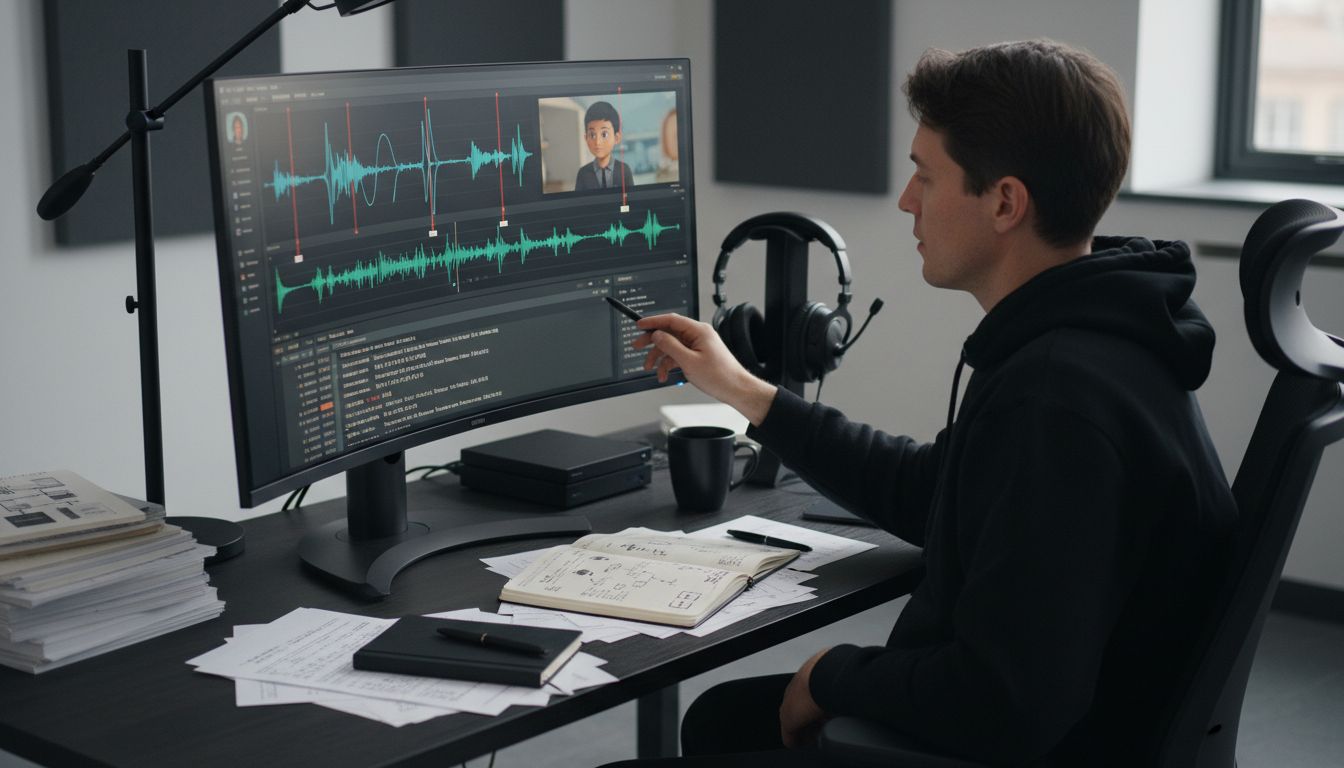
Building upon Wikipedia's audio deepfake research, AI dubbing applications extend far beyond simple translation. These technologies can now generate remarkably convincing speech that mimics specific vocal characteristics, enabling personalized content adaptation across multiple contexts. Key capabilities include:
- Audiobook narration in multiple languages
- Personalized digital assistant voice generation
- Accessibility tools for individuals who have lost speech capabilities
- Multilingual content localization for global media platforms
The technological progression of AI dubbing represents a significant leap in breaking down linguistic barriers, providing creators and businesses with unprecedented tools to communicate across cultural and linguistic boundaries. As machine learning algorithms become increasingly sophisticated, we can anticipate even more nuanced and emotionally intelligent voice replication technologies emerging in the coming years.
How AI Dubbing Technology Works
AI dubbing technology operates through a sophisticated, multi-stage process that transforms audio content across language barriers. The core workflow involves several intricate technological steps designed to preserve the original content's meaning, emotional tone, and vocal characteristics while enabling seamless translation.
Research from ArXiv reveals a comprehensive technology pipeline for cross-lingual dubbing, which typically includes four critical stages: transcription, translation, text-to-speech synthesis, and lip-syncing. Each stage requires advanced machine learning algorithms to ensure accuracy and natural language reproduction. Speech recognition technologies first convert the original audio into text, followed by neural machine translation systems that accurately translate the content while maintaining contextual nuances.
Building upon the research by ArXiv, advanced AI dubbing systems like 'VideoDubber' emphasize speech-aware length control to address one of the most challenging aspects of multilingual dubbing: synchronizing translated speech with the original video's timing. This technique involves:
- Analyzing original speech duration
- Adjusting translated text to match source language timing
- Ensuring lip movements align with synthesized speech
- Maintaining natural speech cadence and emotional resonance
The most sophisticated AI dubbing technologies now integrate multiple artificial intelligence techniques, including deep learning neural networks, natural language processing, and advanced voice synthesis. These systems can dynamically adjust vocal characteristics, preserve speaker-specific vocal signatures, and produce remarkably human-like translations that go far beyond traditional mechanical dubbing methods.
 Learn more about AI in content creation to explore how these technologies are rapidly transforming multimedia communication.
Key Applications and Real-World Use Cases
AI dubbing technology is revolutionizing communication and content creation across multiple industries, offering unprecedented opportunities for global reach and accessibility. From entertainment and media to education and assistive technologies, the applications of AI dubbing are rapidly expanding and transforming how we create and consume multilingual content.
According to AP News, major streaming platforms like Amazon are already pioneering AI-aided dubbing, demonstrating the technology's practical potential. The approach combines artificial intelligence with human oversight, initially focusing on providing English and Latin American Spanish dubs for select movies and series. This hybrid model ensures high-quality translations while leveraging the efficiency of AI technologies.
Research from ArXiv highlights the versatility of AI dubbing through Generative Adversarial Networks (GANs), showcasing multiple groundbreaking applications:
- Automated Movie Dubbing: Enabling seamless multilingual film distribution
- Speech-to-Singing Conversion: Creating musical content across language barriers
- Speech Rehabilitation: Developing assistive devices for individuals with speech challenges
- Educational Content Localization: Translating learning materials for global audiences
Explore practical AI productivity tools to understand how these technologies are transforming communication and content creation. The future of AI dubbing promises even more sophisticated, emotionally nuanced, and culturally sensitive translation technologies that will continue breaking down linguistic barriers and connecting global audiences in unprecedented ways.
Benefits and Limitations of AI Dubbing
AI dubbing represents a transformative technology with profound implications for global communication, offering unprecedented opportunities while simultaneously presenting significant technological and ethical challenges. Understanding its multifaceted nature requires a nuanced exploration of both its remarkable capabilities and inherent limitations.
According to Intel Market Research, the AI video dubbing market is rapidly expanding, providing cost-effective and scalable solutions for content localization. However, the research also highlights critical challenges, including quality limitations in niche languages and complex legal considerations surrounding voice cloning rights. These constraints underscore the technology's current developmental stage and the need for continued refinement.
Research from ArXiv further illuminates the technological frontiers of AI dubbing, proposing advanced multimodal context interaction schemes to enhance prosody expressiveness. The key benefits and limitations can be comprehensively categorized as:
Benefits:
- Rapid, scalable content translation
- Significant cost reduction in localization
- Accessibility for global audiences
- Preservation of original vocal characteristics
Limitations:
- Inconsistent performance across language diversity
- Challenges in capturing emotional nuance
- Complex legal and ethical voice reproduction concerns
- Reduced expressiveness in specialized contexts
Discover insights into AI video technology to understand how these emerging tools are reshaping multimedia communication. While AI dubbing technology continues to evolve, its potential to bridge linguistic barriers and democratize content creation remains extraordinarily promising.
Common Risks, Challenges, and Ethical Concerns
AI dubbing technologies, while revolutionary, present a complex landscape of potential risks and ethical dilemmas that demand careful consideration and proactive management. The rapid advancement of these technologies introduces unprecedented challenges that extend far beyond technical limitations.
According to Wikipedia's research on deepfakes, audio deepfakes pose significant ethical concerns that can potentially undermine trust and authenticity in digital communication. These technologies create substantial risks including:
- Misinformation Propagation: Generating misleading or fabricated content
- Privacy Violations: Unauthorized voice replication without consent
- Identity Manipulation: Creating synthetic representations of individuals
- Potential Legal Complications: Unclear ownership and reproduction rights
Intel Market Research further highlights the complex legal landscape surrounding AI dubbing, emphasizing challenges in niche language segments and intricate voice cloning rights. The technology faces significant barriers in premium content markets, where precise voice reproduction and derivative content ownership become critical considerations.
The primary ethical concerns cluster around consent, authenticity, and potential misuse. Creators and technologists must develop robust frameworks that:
- Establish clear consent mechanisms
- Create transparent usage guidelines
- Implement strong verification processes
- Develop legal protections for voice actors
Understand productivity with AI video technology to gain deeper insights into responsible technological innovation. As AI dubbing continues to evolve, maintaining a delicate balance between technological potential and ethical responsibility will be paramount.
AI Dubbing vs. Traditional Dubbing Methods
The landscape of multilingual content creation is undergoing a profound transformation, with AI dubbing emerging as a disruptive technology challenging long-established traditional dubbing practices. This technological shift represents more than just an incremental improvement—it's a fundamental reimagining of how linguistic barriers can be overcome in multimedia communication.
According to research from MIT Direct, traditional dubbing practices have been fundamentally challenged by emerging AI technologies. The study highlights critical differences between conventional and AI-powered approaches, revealing that vocal naturalness and translation quality are paramount, regardless of the method employed.
A comprehensive comparison reveals the distinct characteristics of AI and traditional dubbing methods:
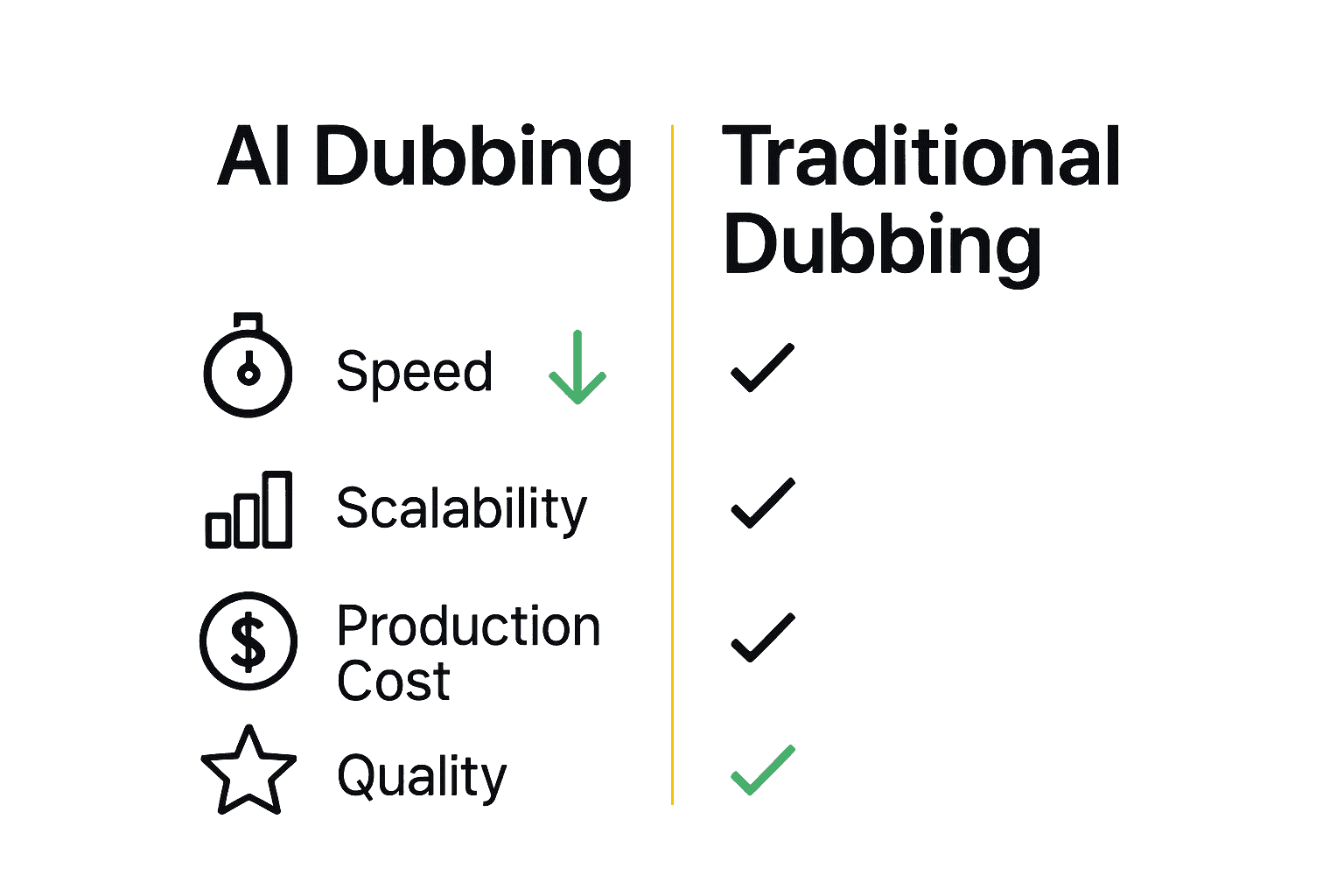
Traditional Dubbing:
- Requires extensive human labor
- High production costs
- Lengthy production timelines
- Relies on professional voice actors
- Limited scalability
AI Dubbing:
- Automated and rapid production
- Significantly reduced costs
- Instantaneous language adaptation
- Consistent voice reproduction
- Highly scalable across multiple languages
Research from the University of Galway emphasizes the ongoing challenges in automated multilingual video dubbing, particularly in data management and synchronization. While AI technologies continue to advance, they must still overcome complex technical hurdles to fully replace traditional methods.
Understand productivity with AI video technology to explore how these emerging tools are revolutionizing content creation. The future of dubbing lies not in complete replacement, but in a sophisticated collaboration between human expertise and artificial intelligence.
Unlock the Full Potential of AI Dubbing with Boom
If you are exploring AI dubbing to break language barriers and deliver authentic, multilingual content with speed and clarity the challenges of traditional dubbing probably sound familiar. The article highlights pain points like preserving vocal naturalness emotional nuance and ensuring perfect synchronization across languages. Boom addresses these very challenges with AI-powered voiceover and multilingual dubbing designed to give you professional-grade results without the common frustrations of manual processes or costly human studios.
With Boom you can:
- Instantly transform your voice recordings into polished videos with precise timing and visuals applied
- Generate and customize scripts to keep your message clear and goal-focused
- Localize your content into multiple languages using pro-grade AI voice models that sound natural and engaging
- Collaborate asynchronously without scheduling meetings to save precious time
Ready to experience AI dubbing the way it should be easy efficient and on brand Stop letting traditional dubbing methods hold you back and start earning time with every video you make. Visit Boom now to discover how to create stunning multilingual content seamlessly or learn more about AI in content creation and AI video technology that power your future of communication.
Frequently Asked Questions
What is AI dubbing?
AI dubbing is a technology that uses artificial intelligence to automatically translate and recreate audio tracks in different languages, preserving the original speaker's vocal characteristics.
How does AI dubbing technology work?
AI dubbing technology works through a multi-stage process involving transcription, translation, text-to-speech synthesis, and lip-syncing to accurately reproduce the original audio content in a different language.
What are the main benefits of using AI dubbing?
The main benefits of AI dubbing include rapid and cost-effective content translation, scalability for global audiences, and the ability to preserve the original vocal characteristics of the speaker.
What are the limitations of AI dubbing compared to traditional dubbing methods?
AI dubbing may face limitations such as inconsistent performance across different languages, challenges in capturing emotional nuance, and potential legal issues regarding voice reproduction rights, unlike traditional methods which rely heavily on professional voice actors.
Recommended
About the Author
Aniket
Software Engineer.