
Complete Guide to What Makes a Video Explainer
What makes a video explainer? This comprehensive guide covers key elements, types, critical features, and best practices for impactful video explainers.
Aniket
Author
Complete Guide to What Makes a Video Explainer

Nearly 90 percent of learners say they understand complex topics better with video explainers than with text alone. For american professionals and educators trying to clarify intricate ideas, the right visual narrative can make all the difference. With clear storytelling and smart design, video explainers bridge the gap between confusion and clarity, offering viewers an engaging way to grasp information that might otherwise feel out of reach.
Table of Contents
Key Takeaways
| Point | Details |
|---|---|
| Effective Communication Tool | Video explainers simplify complex ideas into engaging visual narratives, making them particularly useful in educational and professional settings. |
| Key Characteristics | Successful explainer videos share traits like clarity, brevity, and engaging storytelling techniques that enhance information retention. |
| Strategic Design Elements | Exceptional video explainers utilize intuitive visual design and clear narratives to facilitate cognitive engagement and prevent overload. |
| Common Pitfalls to Avoid | Creators should watch out for information overload and oversimplification, ensuring complex ideas are presented with sufficient nuance and context. |
Defining Video Explainers and Core Concepts
- Defining Video Explainers And Core Concepts
- Essential Elements Of An Effective Video Explainer
- Types Of Video Explainers And Use Cases
- Key Features For Clarity And Engagement
- Common Pitfalls And How To Avoid Them
Video explainers are powerful communication tools designed to break down complex ideas into digestible visual narratives. Unlike traditional presentations, these short-form videos transform abstract concepts into compelling stories that engage viewers quickly and effectively. Concise video formats typically range between 5 and 10 minutes, strategically employing storytelling techniques to illuminate challenging subjects.
At their core, explainer videos serve a fundamental educational purpose. Research indicates these multimedia resources are particularly effective in academic and professional settings, using strategic visualizations to focus on key information. By synthesizing storytelling with graphic representations, explainer videos help audiences understand nuanced topics that might otherwise seem intimidating or overly technical. Branded video strategies can further enhance the communication potential of these dynamic presentations.
The landscape of explainer videos is remarkably diverse, spanning multiple disciplines and communication objectives. While no universal definition exists, these videos share common characteristics: brevity, clarity, and engaging visual storytelling. They excel at translating complex ideas across various domains - from scientific explanations to product demonstrations, educational tutorials to marketing narratives. Successful explainer videos combine concise scripting, strategic visual design, and a narrative approach that transforms potentially dry information into an accessible, memorable experience.
Key characteristics that define exceptional explainer videos include:
Essential Elements of an Effective Video Explainer
- Clear, focused messaging
- Engaging narrative structure
- Professional visual design
- Simplified explanation of complex concepts
- Targeted length (typically 2-10 minutes)
- Strong storytelling techniques
Creating an exceptional video explainer requires a strategic blend of visual design, narrative structure, and cognitive engagement. Video creation techniques play a crucial role in transforming complex information into compelling visual stories that capture and maintain viewer attention. Cognitive accessibility emerges as a critical factor, with research highlighting the delicate balance between informative content and visual complexity.

The visual architecture of an effective explainer video demands careful consideration. Studies reveal that excessive visual complexity can significantly impact viewer engagement, potentially leading to increased pausing, rewinding, and dropout rates. This underscores the importance of creating clean, intuitive visual designs that facilitate smooth information absorption. Strategic visual elements should simplify rather than complicate the learning process, using graphics, animations, and typography that guide viewers through the conceptual landscape without overwhelming their cognitive processing.
Psychological and educational research emphasizes that video explainers must do more than simply present information. Instructional video design should aim to generate situational interest while providing robust conceptual scaffolding. However, creators must be mindful of potential pitfalls, such as generating an illusion of understanding that might lead viewers to overestimate their comprehension of the subject matter.
Key elements that distinguish exceptional video explainers include:
Types of Video Explainers and Use Cases
- Crystal-clear narrative structure
- Visually intuitive design
- Concise and targeted messaging
- Strategic use of animations and graphics
- Emotionally engaging storytelling
- Balanced information density
- Smooth cognitive progression
- Memorable concluding insights
Video explainers represent a diverse communication landscape, with distinct formats designed to address specific informational needs. Collaborative video content strategies reveal two primary narrative approaches: problem-solution videos and direct answer videos. Problem-solution explainers meticulously outline a challenge before presenting a comprehensive resolution, while cut-to-the-chase videos deliver immediate, targeted answers without extensive contextual exploration.
Instructional video methodologies demonstrate the remarkable versatility of explainer videos across different domains. Procedural learning videos excel at breaking down complex tasks into digestible step-by-step demonstrations, providing clear narrations that guide viewers through intricate processes. These videos are particularly effective in educational, technical, and professional training environments, offering visual guidance that transcends traditional text-based instructions.
The strategic application of video explainers spans numerous professional and academic contexts. From marketing presentations and product demonstrations to educational tutorials and technical training, these multimedia resources adapt to diverse communication requirements. Video template design plays a crucial role in determining the effectiveness of explainer videos, ensuring that the visual narrative remains engaging, informative, and aligned with specific communication objectives.
Common types of video explainers include:
Key Features for Clarity and Engagement
- Product demonstration videos
- Educational and training tutorials
- Software walkthrough guides
- Technical process explanations
- Marketing and pitch presentations
- Customer support and FAQ videos
- Onboarding and orientation guides
- Scientific and research concept explanations
Creating compelling video explainers demands a nuanced approach to capturing and maintaining viewer attention. Video communication optimization reveals that contextual clarity emerges as the fundamental cornerstone of effective visual storytelling. Research demonstrates that successful explainer videos must seamlessly integrate linguistic and visual elements to ensure comprehensive understanding.
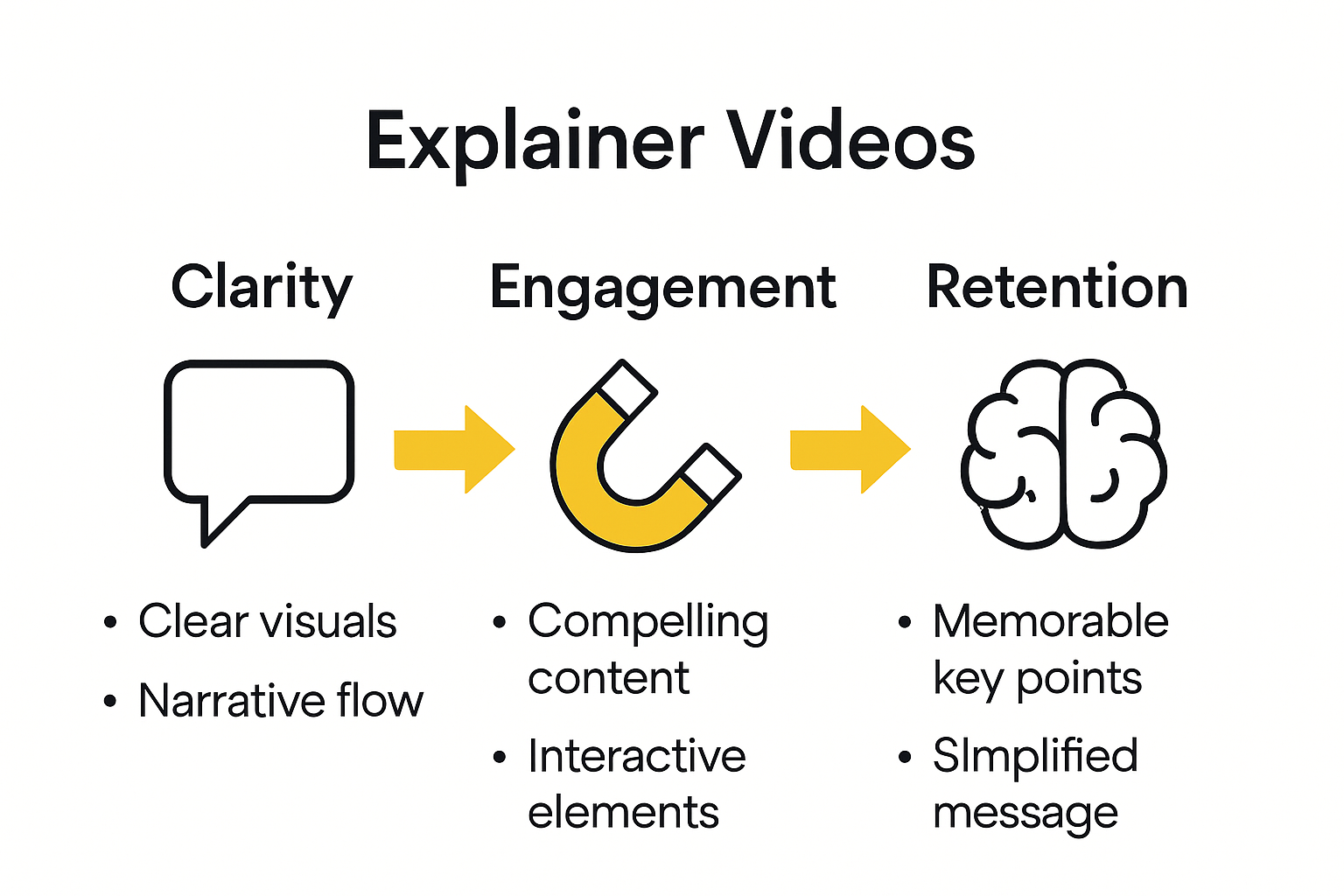
Advanced video summarization techniques highlight the critical importance of preserving essential information across both auditory and visual channels. Causal semantic modeling becomes a powerful strategy for enhancing viewer comprehension, allowing creators to construct narratives that explain complex concepts with remarkable precision. By strategically mapping relationships between ideas and visual representations, video explainers can transform intricate information into digestible, engaging content.
The psychological dynamics of viewer engagement require a multifaceted approach to content design. Effective explainer videos must balance information density with narrative flow, using visual cues and storytelling techniques that maintain cognitive interest. Concise video reporting emphasizes the importance of creating a narrative arc that guides viewers through complex topics without overwhelming their cognitive processing capabilities.
Key features that drive clarity and engagement include:
Common Pitfalls and How to Avoid Them
- Precise, jargon-free language
- Intuitive visual metaphors
- Consistent narrative pacing
- Strategic information hierarchy
- Emotional resonance
- Clear visual transitions
- Contextual framing of complex concepts
- Memorable concluding insights
Creating video explainers requires navigating a complex landscape of potential communication challenges. Video optimization strategies reveal that cognitive overload represents one of the most significant barriers to effective learning. Creators must carefully balance information density with viewer comprehension, avoiding the temptation to cram too much content into a single presentation.
Research on learning misconceptions highlights a critical psychological phenomenon known as the illusion of explanatory depth. Viewers often overestimate their understanding after watching explainer videos, particularly when content oversimplifies complex topics or presents information without sufficient nuance. This cognitive trap can lead to dangerous misconceptions, undermining the very purpose of educational content.
Mitigating these risks requires a strategic approach to content design and viewer engagement. Video reporting techniques suggest implementing targeted strategies to enhance genuine comprehension. By incorporating prompt questions, creating multi-layered explanations, and avoiding oversimplification, creators can transform potential pitfalls into opportunities for deeper learning and critical thinking.
Common pitfalls to watch for include:
Harness the Power of Clear and Engaging Video Explainers with Boom
- Information overload
- Oversimplification of complex concepts
- Lack of clear narrative structure
- Inconsistent visual messaging
- Neglecting viewer cognitive processing limits
- Failing to provide context
- Using excessive technical jargon
- Ignoring viewer prior knowledge
- Monotonous presentation style
- Absence of memorable takeaways
The article highlights key challenges in creating effective video explainers such as maintaining clarity, avoiding information overload, and delivering a strong narrative that resonates with viewers. Many struggle with balancing complex concepts and viewer comprehension while keeping engagement high. If you want to break down intricate ideas effortlessly with clean visuals and precise messaging Boom offers tools built exactly for this purpose.
Boom’s AI-powered async video platform transforms your raw voice into polished on-brand videos using features like auto-scripting and AI voiceover with multilingual dubbing. With Boom you can quickly produce video explainers that combine clear storytelling with professional design so you never lose viewer attention or cause cognitive overload. Say goodbye to scheduling hassles and hello to smart, strategic video communication.
Elevate your explainer videos today and save hours on production while earning back your time.
Create smarter explainer videos that educate and engage right now. Visit Boom’s main site to start for free and discover how video template design helps you stay visually consistent with zero effort. Take control of your communication and make every video count.
Frequently Asked Questions
What is the purpose of a video explainer?
Video explainers are designed to break down complex ideas into digestible visual narratives, helping audiences understand nuanced topics quickly and effectively.
What are the key characteristics of an effective explainer video?
Key characteristics include clear messaging, engaging narrative structure, professional visual design, simplified explanations of complex concepts, and strong storytelling techniques.
How long should a video explainer typically be?
A typical video explainer should be concise, with a strategic length usually ranging between 2 to 10 minutes, depending on the complexity of the subject matter.
What common pitfalls should be avoided when creating a video explainer?
Common pitfalls include information overload, oversimplification of complex ideas, lack of clear narrative structure, and using excessive technical jargon that confuses viewers.
Recommended
About the Author
Aniket
Software Engineer.