
Role of AI in Teamwork: Boosting Productivity and Collaboration
Role of AI in teamwork explained—discover AI-powered async tools, key benefits, potential risks, and how AI redefines collaboration for global teams.
Kunal
Author
Role of AI in Teamwork: Boosting Productivity and Collaboration

Most American teams are seeing a dramatic shift as Artificial Intelligence redefines how groups collaborate and get work done. With over 60 percent of organizations now experimenting with AI-driven tools, the benefits are hard to ignore. As digital environments grow more complex, understanding AI’s role in teamwork can help leaders unlock new levels of insight and productivity. This guide shows how intelligent technology is changing team interaction and what it means for American professionals today.
Table of Contents
Key Takeaways
| Point | Details |
|---|---|
| AI Enhances Team Dynamics | AI-driven tools and systems improve collaboration by streamlining communication and decision-making processes. |
| Real-Time Support and Insights | Intelligent AI agents can analyze interactions and provide insights, boosting team performance without constant human oversight. |
| Addressing Ethical Concerns | Organizations must implement governance frameworks to manage algorithmic bias and ensure data privacy in AI applications. |
| Integrate AI Thoughtfully | Teams should strategically adopt AI technologies based on specific workflow challenges, ensuring they complement existing processes. |
Defining AI's Role in Modern Teamwork
- Defining AI's Role in Modern Teamwork
- AI-Powered Teamwork Tools and Technologies
- Enhancing Team Productivity and Communication
- Risks, Ethical Concerns, and AI Limitations
- Maximizing Collaboration With AI-Driven Workflows
Artificial Intelligence has transformed teamwork from a traditional collaborative process into a dynamic, intelligent ecosystem. Modern teams are no longer constrained by manual coordination but empowered by AI technologies that streamline communication, enhance decision making, and optimize productivity. AI-powered collaboration tools are revolutionizing how teams interact, plan, and execute projects across diverse work environments.
Researchers at Rice University have developed innovative approaches to understanding AI's collaborative potential. Their 'Socratic' AI agent demonstrates how intelligent systems can analyze team interactions and provide real-time coaching tips, dramatically improving team performance without requiring constant human intervention. This breakthrough highlights AI's capacity to serve as an intelligent facilitator, offering insights and recommendations that human managers might overlook.
The impact of AI on teamwork extends beyond simple task automation. By leveraging machine learning algorithms, AI can identify communication patterns, predict potential conflicts, and suggest optimal collaboration strategies. Harvard's Digital Data Design Institute notes that AI technologies influence team dynamics across different adoption phases, either substituting or enhancing human teamwork through intelligent information processing. Teams can now access predictive analytics, automated scheduling, intelligent task allocation, and personalized productivity recommendations that were unimaginable just a few years ago.
Pro Tip for Team Leaders: Integrate AI collaboration tools strategically by first understanding your team's specific workflow challenges and selecting AI solutions that directly address those pain points, rather than adopting technology for technology's sake.
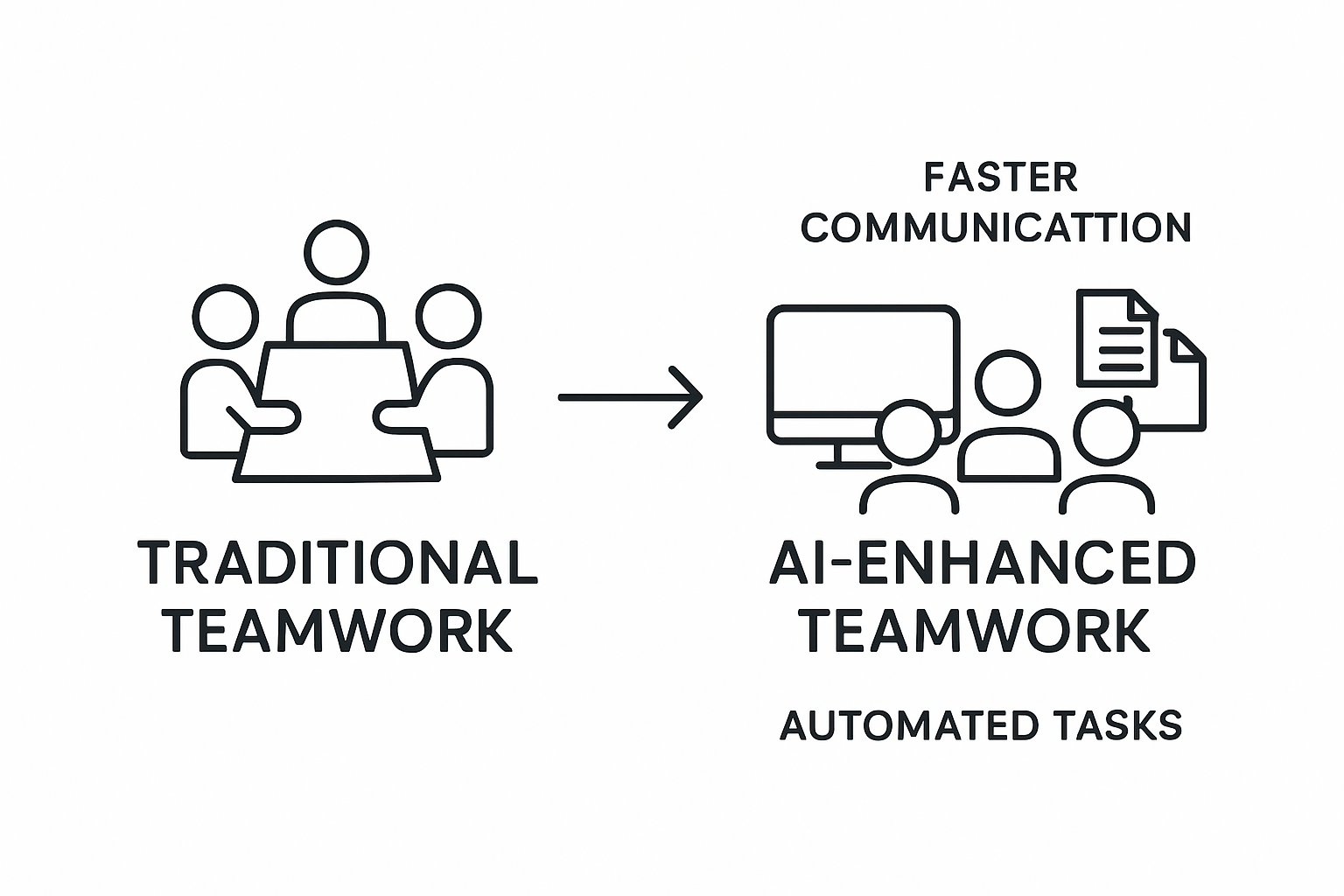
Here's a comparison of traditional teamwork versus AI-enhanced teamwork:
| Aspect | Traditional Teamwork | AI-Enhanced Teamwork |
|---|---|---|
| Coordination | Manual scheduling and allocation | Automated task distribution |
| Communication | Email and static meetings | Real-time AI-mediated chats |
| Decision Making | Human-driven, slower | Data-driven, AI-guided |
| Conflict Prediction | Relies on human intuition | AI identifies emerging tensions early |
| Productivity Tracking | Manual reporting | Automated analytics and suggestions |
AI-Powered Teamwork Tools and Technologies
Artificial Intelligence has rapidly transformed teamwork technologies, introducing powerful tools that enhance collaboration, communication, and productivity across diverse professional environments. Practical AI productivity tools are reshaping how teams interact, plan, and execute complex projects with unprecedented efficiency and precision.
Recent research from MIT highlights the potential of sophisticated AI assistants in team dynamics. AI systems that monitor team interactions can now align team members' perspectives, intervene when communication breaks down, and provide real-time guidance in challenging collaborative scenarios. These intelligent systems are particularly valuable in high-stakes environments like emergency response and search and rescue operations, where precise coordination can mean the difference between success and failure.
Universities are also pioneering AI integration in collaborative learning environments. At Tulane University's Freeman School of Business, students now work alongside AI 'teammates' with defined roles, experiencing how intelligent technologies can foster critical thinking and enhance team performance. These AI-powered tools offer capabilities far beyond traditional project management software, including predictive analytics, intelligent task allocation, real-time translation, sentiment analysis, and personalized productivity recommendations.
Pro Tip for Tech Leaders: Evaluate AI collaboration tools based on their ability to solve specific team workflow challenges, prioritizing solutions that integrate seamlessly with existing communication platforms and provide tangible productivity metrics.
Enhancing Team Productivity and Communication
Artificial Intelligence has emerged as a transformative force in team dynamics, offering unprecedented opportunities to enhance productivity and communication across professional environments. Types of video content for team collaboration have revolutionized how teams share information, breaking down traditional communication barriers and enabling more fluid, efficient interactions.
Research from Harvard Business School reveals how AI can function as a sophisticated cybernetic teammate, generating innovative ideas and sharing expertise that significantly improves team performance and engagement. By acting as an intelligent collaborator, AI helps teams transcend traditional limitations, providing insights and suggestions that might otherwise remain unexplored.
Carnegie Mellon University researchers are pioneering approaches that position AI as a supportive partner in human collaboration, focusing on technologies that strengthen collective intelligence rather than replace human contribution. These advanced systems analyze communication patterns, identify potential bottlenecks, and suggest optimization strategies that enable teams to work more cohesively. The goal is not to automate human interaction but to enhance it, creating a symbiotic relationship where AI amplifies team capabilities and helps individuals communicate more effectively.
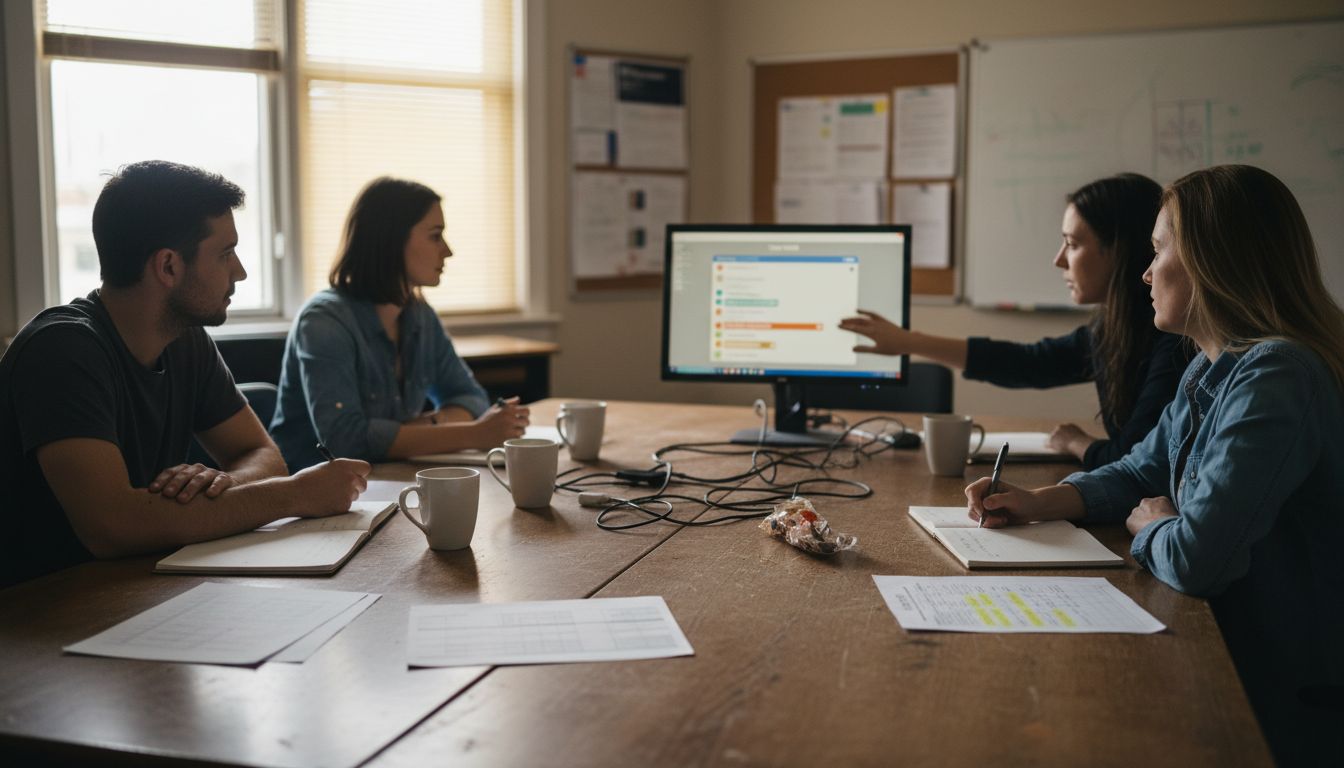
Pro Tip for Collaboration Leaders: Implement AI communication tools strategically by first understanding your team's unique communication challenges, then selecting solutions that complement your existing workflow and communication styles.
Risks, Ethical Concerns, and AI Limitations
Artificial Intelligence in teamwork presents a complex landscape of potential benefits and significant challenges that demand careful, nuanced consideration. Comprehensive research on AI's impact on organizational dynamics reveals critical ethical considerations that extend far beyond technological capabilities, highlighting the need for responsible implementation and ongoing critical evaluation.
The primary ethical concerns surrounding AI in teamwork center on several key dimensions. Algorithmic bias represents a fundamental challenge, where AI systems can inadvertently perpetuate existing social prejudices through training data and embedded decision-making frameworks. Privacy becomes another critical concern, as AI technologies often require extensive data collection and analysis that can compromise individual team members' confidential information. Communication strategies in human-AI team environments emphasize the importance of transparent, structured interactions that maintain human agency and prevent potential manipulation.
Organizations must develop robust governance frameworks that address AI's limitations and potential risks. These frameworks should include comprehensive guidelines for AI deployment, ongoing algorithmic auditing, clear accountability mechanisms, and continuous human oversight. Key considerations include establishing ethical boundaries, ensuring data protection, maintaining transparent decision-making processes, and creating opportunities for human intervention and correction when AI systems demonstrate potential errors or biased recommendations.
Pro Tip for Ethical AI Implementation: Develop a cross-functional AI ethics committee that includes diverse perspectives from technology, legal, HR, and operational departments to create comprehensive guidelines for responsible AI integration.
Key risks and mitigation strategies for AI in teamwork environments:
| Risk | Example Scenario | Mitigation Strategy |
|---|---|---|
| Algorithmic Bias | Discriminatory task assignments | Regular audits and diverse training data |
| Data Privacy | Sensitive project data exposure | Robust encryption and access controls |
| Reduced Human Agency | Over-reliance on AI suggestions | Maintain human override and transparency |
| Miscommunication | Misinterpreted AI recommendations | Clear documentation and user education |
Maximizing Collaboration With AI-Driven Workflows
Artificial Intelligence is transforming collaboration by introducing sophisticated workflow optimization strategies that enable teams to work more intelligently and efficiently. Understanding productivity through AI video technology reveals how intelligent systems can streamline complex team interactions and enhance overall performance.
Structured team roles for AI-based teammates represent a critical breakthrough in human-machine collaboration, offering a systematic approach to integrating artificial intelligence into team environments. These advanced multi-agent systems enable precise task allocation, intelligent workload distribution, and real-time performance optimization, creating a dynamic ecosystem where AI and human intelligence work in seamless harmony.
Research exploring human-machine teamwork demonstrates the immense potential of collective intelligence in AI-driven workflows. By developing sophisticated interaction protocols, organizations can leverage AI technologies to augment human capabilities, predict potential workflow bottlenecks, and generate innovative problem-solving strategies. The key lies in creating flexible, adaptive systems that respect human creativity while providing data-driven insights and operational efficiency.
Pro Tip for Workflow Optimization: Design AI collaboration frameworks with clear role definitions, ensuring that artificial intelligence serves as an intelligent assistant rather than a replacement for human expertise.
Transform Teamwork with AI-Powered Async Video from Boom
The article highlights how AI reshapes productivity, communication, and collaboration by automating workflows, offering real-time feedback, and breaking down traditional meeting barriers. Teams face challenges like scheduling conflicts, inefficient decision-making, and communication bottlenecks that slow progress and drain energy. With concepts like AI-mediated chats, predictive analytics, and enhanced collaboration workflows, there is a clear demand for smart tools that save time and streamline teamwork.
Boom answers this need by providing an AI-powered async video platform designed to replace time-consuming meetings while boosting team clarity and control. Features like voice-to-video recording, auto-scripting, AI voiceover, and multilingual dubbing help you create polished, on-brand videos that communicate your message effectively without sacrificing precious hours. Boom’s async-first design eliminates scheduling stress so teams can collaborate seamlessly at their own pace. Discover how Boom’s AI-driven video tools complement the article’s vision of smarter AI teamwork and unlock new levels of productivity.
Learn more about AI productivity tools with Boom and see how it transforms communication in modern teams.
Ready to boost your team’s performance and reduce meeting overload? Visit Boom’s landing page now to start earning back your time and revolutionize how your team collaborates each day.
Frequently Asked Questions
How does AI enhance productivity in teamwork?
AI enhances productivity by automating task distribution, providing real-time analytics, and offering personalized productivity recommendations, allowing teams to focus on more strategic initiatives.
What are some examples of AI-powered collaboration tools?
Examples include AI systems for automated scheduling, intelligent task allocation, predictive analytics for project management, and real-time communication tools that facilitate seamless team interactions.
How can teams mitigate the risks associated with AI in collaboration?
Teams can mitigate risks by implementing robust governance frameworks, conducting regular audits for algorithmic bias, ensuring data protection practices, and maintaining human oversight in decision-making processes.
What role does AI play in conflict prediction and resolution in teams?
AI analyzes communication patterns to identify potential conflicts early, allowing teams to address tensions proactively and improve overall collaboration dynamics.
Recommended
About the Author
Kunal
Software Engineer.